
Educational overview for specifiers, engineers, and fire protection contractors.
This guide highlights Fire Collar applications and their role in sealing joints.
The Weakest Point in Your Fire Compartment
A fire-rated wall or floor is only as strong as its weakest penetration. A Fire Collar around penetrations strengthens the barrier. If a combustible plastic pipe passes through a rated assembly and catches fire, the pipe melts and collapses within minutes. Flame, smoke and toxic gases then travel freely between fire compartments, often long before the structure itself is threatened.
The International Building Code (IBC) addresses this directly. IBC Section 714 requires that through-penetration firestop systems at combustible pipe penetrations be tested and listed in accordance with ASTM E814 / UL 1479. The same requirement appears in NFPA 101 (Life Safety Code) and is enforced by local Authorities Having Jurisdiction (AHJs). A penetration without a tested, listed firestop device is a code violation — regardless of how good the pipe or the wall looks.
What “UL1479 Listed” Actually Means
UL 1479 is the North American standard for through-penetration firestops. It is not a self-certification: representative product samples are physically tested at a UL facility, and UL’s ongoing surveillance program verifies that listed products continue to meet the standard.
A UL1479 listing is expressed with two ratings you will see on every compliant submittal.
- F Rating — how long the assembly stops flame and hot gas passage.
- T Rating — how long the assembly keeps the temperature on the unexposed side below a defined limit.
Independent testing matters because firestop performance cannot be judged by appearance. A Fire Collar that looks identical may expand later, expand less, or fail to generate enough pressure. The listing, verified against the UL Product iQ database, is evidence engineers, contractors and inspectors can rely on.
Independent testing matters becausefire stop performance cannot be judged by appearance. A collar that looks identical may expand later, expand less, or fail to generate enough pressure to crush a melting pipe. The listing, verified against the UL Product iQ database, is the evidence an engineer, contractor and inspector can all rely on.
What Happens When the System Is Not Certified
Firestop errors are among the most common violations cited in code-enforcement reviews. Typical consequences include:
- Failed inspections — the AHJ rejects the penetration, delaying occupancy and adding rework cost.
- Specification rejection — projects governed by IBC / NFPA 101 cannot legally accept an unlisted system.
- Liability exposure — if a fire breaches a non-compliant penetration, the responsibility falls on the designer, the installer and the product supplier.
- Insurance impact — underwriters increasingly review
fire stop
- compliance documentation on commercial and multi-family risks.
In short: for a fire-rated assembly, an unlistedfire stop
device is not a “budget alternative” — it is a defect.
How an Intumescent Fire Collar Works
A fire collar is a metal housing containing an expandable graphite intumescent strip, installed around the pipe at the surface of the wall or floor. The graphite stays inert at normal operating temperatures. When the surrounding temperature rises, the sequence is:
1. The plastic pipe begins to melt and lose structural form. 2. The intumescent graphite activates and expands inward under pressure. 3. The expanding material crushes and fills the void as the pipe collapses. 4. A dense carbonaceous char forms, sealing the penetration against flame, smoke and hot gas. 5. Fire compartmentation is restored within the rated assembly.
Once correctly installed, a fire collar requires no maintenance or periodic inspection.
What Leading Brands Emphasize
Across the market, the establishedfire stop
manufacturers — Hilti with its CP 600-series collars and wrap strips, Specified Technologies, ROCKWOOL and others — lead their product documentation with the same message: certification is the product. Hilti, for example, presents its collars as “UL compliant,” “FM approved” and “BS compliant,” combining third-party marks to prove performance. The pattern is consistent: for through-penetration firestopping, the listing mark is the specification, and the hardware is specified only as part of a tested system.
That is why an increasing share of fire collar sourcing is moving to manufacturers who can deliver their own independent listings with full documentation — not just a component that could be used in someone else’s certified system.
FEG40: A UL1479-Listed Fire Collar You Can Specify with Full Documentation
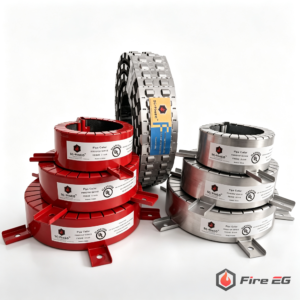
The FEG40 Intumescent Fire Collar, manufactured by FireEG (Shengchang Chemical Co., Ltd.), is one of the first fire collars produced by a Chinese manufacturer to carry its own UL1479 listing. FireEG has manufactured expandable graphite and intumescent materials in Huai’an County, Hebei Province since 1993, and has supplied distributors, contractors and OEMs across more than 30 countries.
| Certificate Number | R40652 |
| UL File Number | XHJI.R40652 |
| System Number | C-AJ-2941 |
| Standard | ANSI/UL 1479 (ASTM E814) |
| Fire Rating | F Rating 3 Hr / T Rating 3 Hr |
| Issue Date | August 30, 2023 |
| Issued To | Huai’anXian Sheng Chang FireEG Co., Ltd. |
| Verification | Search “R40652” or “C-AJ-2941” in the UL Product iQ database (iq.ulprospector.com) |
Key performance data:
- Activation temperature: from 180°C (356°F) — the graphite begins expanding before the pipe fully collapses, sealing the opening early in the fire.
- Expansion ratio: 35–45x (free expansion at 450°C, 30 min), generating the pressure needed to crush and fill the void.
- Certified pipe materials: PVC, CPVC, ABS, FRPP, HDPE.
- Size range: 1.5″ – 4″ (38 – 102 mm pipe).
- Shell options: powder-coated carbon steel (standard), galvanized steel, or stainless steel.
- Compatible substrates: normal-weight and lightweight concrete, hollow-core precast, CMU, gypsum wallboard and masonry.
- Also certified: China CCC (GB 16670, 2018) for the domestic market; ISO 9001 quality management (2012).
The FEG40 is engineered for exactly the scenario codes are written for: combustible pipe penetrations in high-rise residential, commercial, healthcare, industrial and infrastructure projects governed by IBC or NFPA 101.
How to Verify a Firestop Listing Before You Buy
When any supplier claims a UL listing, verify it the same way inspectors do:
1. Ask for the certificate number and UL system number — never accept “UL approved” without them. 2. Search the number in the UL Product iQ database (iq.ulprospector.com). 3. Confirm the listed pipe materials, sizes and F/T ratings match your application. 4. Request the Certificate of Compliance for your project file.
For the FEG40, the numbers are R40652 / C-AJ-2941 — and the certificate is available on request.
Summary
A UL1479-listed fire collar is not a premium accessory; it is the compliance baseline for combustible pipe penetrations in fire-rated construction. Independent testing under UL 1479 gives engineers and contractors what an inspection report needs: an F/T-rated, code-recognized system with verifiable documentation.
The FEG40 delivers that baseline — with a verifiable listing (R40652 / C-AJ-2941), 180°C activation, a 35–45x expansion ratio, and 30+ years of graphite and intumescent manufacturing behind it — for projects where the listing mark is the specification.
Questions on pipe sizes, substrates or project documentation? Contact FireEG: sales@fireeg.com | +86-313-7853886 | https://fireeg.com
发表回复